

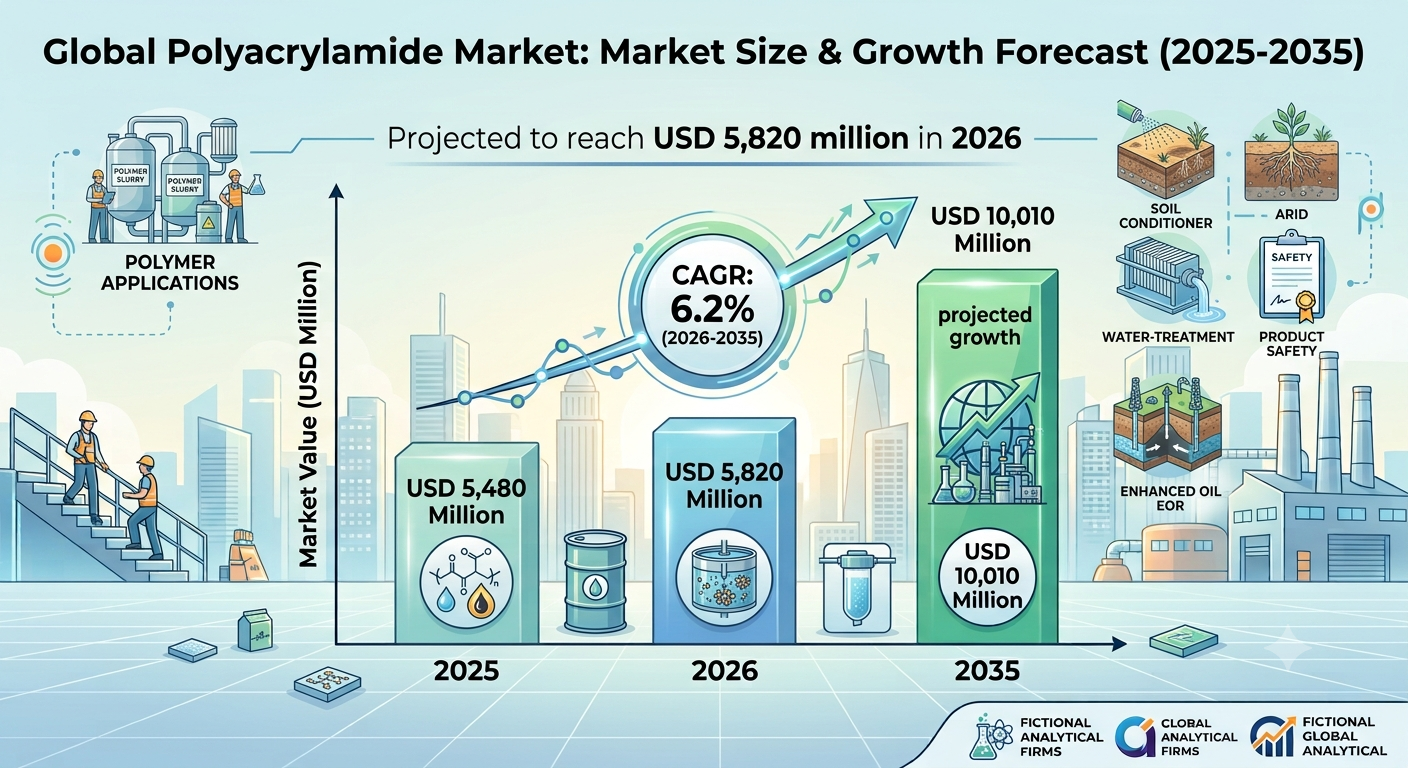
Polyacrylamide Market to Grow from USD 5,820 Million in 2026 to USD 10,010 Million by 2035 at 6.2% CAGR
Polyacrylamide Market (2026 - 2035)
Asia-Pacific led the Polyacrylamide Market in 2025 with 53.4% share and is expanding at a 6.7% CAGR through 2035
HI, UNITED STATES, August 27, 2026 /EINPresswire.com/ -- The Polyacrylamide Market is gaining importance across water treatment, oil and gas, mining, pulp and paper, and other industrial applications as industries increasingly focus on efficient separation, sludge management, resource recovery, and wastewater treatment. Polyacrylamide is a synthetic polymer derived from acrylamide and is widely used as a flocculant, thickener, rheology modifier, and processing aid. Its ability to improve solid-liquid separation and support efficient treatment processes makes it an important chemical across several industrial value chains.According to Market Research Future, the global Polyacrylamide Market was valued at USD 5,480 million in 2025 and is projected to grow from USD 5,820 million in 2026 to approximately USD 10,010 million by 2035, registering a CAGR of 6.2% CAGR during 2026–2035.
Expanding Wastewater Infrastructure Drives Demand
The expansion of municipal and industrial wastewater infrastructure is one of the strongest growth drivers for the Polyacrylamide Market. Population growth, urbanization, industrialization, and increasingly stringent wastewater-discharge requirements are encouraging governments and industries to invest in treatment facilities.
Polyacrylamide is used in clarification, sludge thickening, and dewatering operations. It helps wastewater operators improve the separation of suspended solids from water and can increase the efficiency of sludge-handling processes.
Developing economies in Asia-Pacific, South America, and other emerging regions are investing heavily in wastewater infrastructure. As new treatment plants are constructed and existing facilities are upgraded, demand for water-treatment polymers is expected to increase.
The market report identifies municipal wastewater infrastructure expansion as a major long-term catalyst, particularly in Asia-Pacific.
Water Treatment Remains the Largest Application
By application, the market includes Flocculants for Water Treatment, Enhanced Oil Recovery, Soil Conditioner, and Other Applications. Flocculants for water treatment represented 44.4% of market revenue in 2025, making it the leading application segment.
Polyacrylamide-based flocculants are widely used to aggregate fine particles and improve sedimentation. Municipal wastewater plants use these polymers during sludge conditioning and dewatering, while industrial facilities use them to treat wastewater generated by manufacturing and processing operations.
Industrial wastewater from mining, chemicals, food processing, textiles, metals, and other sectors often contains suspended solids that require effective separation. Polyacrylamide provides a flexible treatment solution because its molecular weight and charge characteristics can be adjusted for different wastewater conditions.
Download Report Sample Copy with TOC: https://www.marketresearchfuture.com/sample_request/7910
Enhanced Oil Recovery Creates a High-Growth Opportunity
Enhanced oil recovery is another important application for polyacrylamide. Polymer flooding involves injecting polymer-containing water into reservoirs to improve sweep efficiency and push additional crude oil toward production wells.
The Enhanced Oil Recovery segment is projected to grow at a 6.7% CAGR through 2035, making it one of the fastest-growing applications.
Polyacrylamide can increase the viscosity of injected water, helping reduce water mobility and improve contact with remaining oil within mature reservoirs. This makes polymer flooding particularly attractive for oilfields where conventional production methods are no longer achieving desired recovery levels.
North America and the Middle East represent important markets for oilfield applications, while mature oil-producing regions continue to evaluate advanced recovery techniques to extend field productivity.
Powder Form Holds a Leading Position
By physical form, the market is segmented into Powder, Liquid, and Emulsion/Dispersions. Powder formulations accounted for 46.8% of global revenue in 2025, making them the leading physical form.
Powder polyacrylamide is widely used because of its storage stability, transportation efficiency, and suitability for large-volume industrial applications. Municipal wastewater treatment facilities and industrial users can purchase dry polymer in bulk and prepare treatment solutions according to operational requirements.
Powder products are particularly attractive for large facilities where cost efficiency is a major purchasing consideration.
However, emulsion and dispersion formulations are becoming increasingly important as treatment facilities automate chemical dosing. These products can simplify handling and provide faster preparation, making them suitable for facilities where dosing precision and operational efficiency are priorities.
Emulsion and Dispersion Products Gain Momentum
The Emulsion/Dispersions segment is expected to grow at a 6.6% CAGR through 2035.
Ready-to-use or easily dispersed formulations can reduce the need for extensive polymer preparation infrastructure. This is particularly valuable for automated treatment facilities, smaller industrial plants, and applications where consistent dosing is important.
Digital dosing equipment can also be integrated with these formulations to optimize polymer consumption according to flow rates, turbidity, and sludge characteristics.
As treatment plants move toward automated operations, the demand for convenient and precision-oriented polymer formats is expected to increase.
Buy Now: https://www.marketresearchfuture.com/checkout?currency=one_user-USD&report_id=7910
Oil and Gas Industry Supports Market Expansion
By end-user industry, Water Treatment accounted for 44.2% of market revenue in 2025, maintaining its position as the largest end-use sector. Oil and gas, however, represents one of the fastest-growing industries, with a projected 6.6% CAGR through 2035.
In oilfield operations, polyacrylamide is used for polymer flooding, drilling fluids, and other specialized processes. High-molecular-weight and salt-tolerant grades can be developed for demanding reservoir environments.
Growing interest in maximizing recovery from mature oilfields is expected to support consumption. Operators are increasingly evaluating chemical-enhanced recovery techniques as a way to improve production without relying exclusively on new field development.
Mining Applications Expand with Critical Mineral Demand
Mining represents another significant opportunity for polyacrylamide producers. The polymer can assist with mineral processing, tailings treatment, clarification, and solid-liquid separation.
The mining end-user segment is projected to grow at approximately 6.4% CAGR through 2035.
The expansion of lithium, copper, nickel, and other critical-mineral production is creating new demand for efficient tailings and wastewater management. Mining companies increasingly need to recover process water while improving the stability and handling of tailings.
Polyacrylamide can help accelerate settling and improve water recovery, making it useful in mining operations where water availability and environmental compliance are major considerations.
Pulp and Paper Industry Remains an Important Consumer
The pulp and paper industry uses polyacrylamide as a retention and drainage aid during paper manufacturing. It can improve fiber retention, support water removal, and increase process efficiency.
The report estimates the pulp and paper segment at approximately USD 385 million in 2025.
Increasing demand for packaging paper and tissue products is supporting consumption of process chemicals. E-commerce growth has also increased demand for corrugated packaging and paperboard products.
Manufacturers are simultaneously seeking chemicals that can improve production efficiency while reducing water and energy consumption.
Regulatory Standards Increase Demand for High-Purity Grades
Increasing regulatory scrutiny of residual acrylamide monomer is influencing product development. Polyacrylamide products used in sensitive applications, particularly drinking-water treatment, must meet strict safety and purity requirements.
This is encouraging manufacturers to invest in improved purification processes and low-residual-monomer formulations.
The market is therefore gradually moving toward a more differentiated product landscape, where certified high-purity grades can command higher prices than commodity products.
For manufacturers, maintaining compliance and demonstrating consistent product quality can become an important competitive advantage.
Semiconductor Manufacturing Creates a Specialty Opportunity
The expansion of semiconductor manufacturing is creating demand for highly purified water-treatment polymers. Advanced semiconductor facilities consume significant quantities of water and generate complex wastewater streams that require precise treatment.
The market report identifies semiconductor-grade ultra-pure formulations as an emerging opportunity. These products can command premium pricing because they must satisfy demanding purity and performance requirements.
Taiwan, South Korea, Japan, China, and North America are investing in semiconductor manufacturing capacity. As these facilities expand, specialized wastewater-treatment requirements could create a new high-value niche for polyacrylamide producers.
Report Summary: https://www.marketresearchfuture.com/reports/polyacrylamide-market-7910
Bio-Based Polymer Alternatives Gain Attention
Sustainability is influencing innovation across the industry. Bio-based flocculants based on materials such as chitosan, starch, and cellulose are being investigated as alternatives or complementary products.
These materials can offer renewable feedstock advantages and may appeal to customers seeking lower environmental impacts.
However, synthetic polyacrylamide continues to offer strong performance across high-volume applications. The challenge for bio-based alternatives is achieving competitive costs, consistent performance, and scalability.
The development of bio-grafted polyacrylamide derivatives could provide a middle ground by combining the performance characteristics of synthetic polymers with renewable components.
Digital Chemical Management Improves Efficiency
Digitalization is creating another opportunity within the Polyacrylamide Market. Treatment facilities are increasingly adopting sensors, automated dosing systems, process monitoring, and data analytics.
Real-time monitoring of turbidity, flow, pH, and sludge characteristics can help operators adjust polymer dosage according to changing treatment conditions.
This approach can reduce chemical consumption, improve effluent quality, and lower operating costs. Suppliers that combine polymers with dosing equipment, monitoring systems, and technical services can potentially develop longer-term customer relationships.
The transition toward chemical-as-a-service models may further change how industrial customers purchase water-treatment chemicals.
Feedstock Price Volatility Creates Challenges
Despite strong growth prospects, raw-material volatility remains a challenge for polyacrylamide producers. Acrylonitrile is an important feedstock in the production chain, and changes in petrochemical prices can influence acrylamide and polymer production costs.
Fluctuations in energy prices, refinery operations, supply disruptions, and regional capacity can create additional uncertainty.
Manufacturers with integrated supply chains may have greater control over costs, while smaller producers can face greater margin pressure.
Improving production efficiency, optimizing formulations, and securing long-term feedstock supply agreements can help producers manage these challenges.
Water Recycling Influences Chemical Consumption
The increasing adoption of water recycling and closed-loop systems can have mixed effects on the Polyacrylamide Market.
On one hand, recycling reduces the volume of fresh water required by industrial facilities and increases the importance of efficient treatment technologies. On the other hand, highly optimized closed-loop systems can reduce the amount of wastewater requiring treatment.
This trend is encouraging demand for higher-performance polymers that can operate effectively under more concentrated and complex treatment conditions.
The market is therefore shifting from volume-driven demand toward performance-driven value in several advanced applications.
Asia-Pacific Leads the Global Market
Asia-Pacific accounted for approximately 53.4% of global Polyacrylamide Market revenue in 2025, making it the dominant regional market. The region is projected to grow at approximately 6.7% CAGR through 2035.
China represents a major contributor because of its extensive municipal wastewater infrastructure, industrial manufacturing base, mining activities, and oilfield applications.
India is also emerging as an important growth market due to expanding water infrastructure and increasing investments in wastewater treatment.
Japan and South Korea contribute to premium demand through advanced industrial treatment applications and semiconductor manufacturing.
North America Benefits from Oilfield Demand
North America represents approximately 20% of global market revenue, supported by oil and gas applications, industrial wastewater treatment, and tightening regulatory requirements.
The region's shale oil and gas industry provides opportunities for enhanced oil recovery technologies. Mature reservoirs require advanced recovery methods to maintain production, creating demand for specialized polymer grades.
The United States is also investing in semiconductor and advanced manufacturing facilities, providing additional opportunities for high-purity water-treatment products.
Europe Emphasizes Wastewater Upgrades
Europe represents approximately 17% of the global market and is being influenced by increasingly stringent wastewater-treatment requirements.
Upgrades to municipal wastewater facilities are creating demand for advanced flocculation and sludge-treatment solutions.
At the same time, European customers are showing greater interest in renewable and bio-based chemical alternatives. This is encouraging manufacturers to develop lower-impact formulations and explore bio-grafted polymers.
South America Offers Mining Opportunities
South America is becoming an important market for polyacrylamide because of its mining and mineral-processing industries.
Chile, Argentina, Brazil, and other countries are expanding production of lithium, copper, iron ore, and other minerals. These activities require significant quantities of water and generate large volumes of tailings.
Polyacrylamide can support water recovery and solid-liquid separation, making it valuable for mining operations seeking to improve resource efficiency and environmental performance.
Competitive Landscape
The global Polyacrylamide Market includes major companies such as SNF Group, Kemira Oyj, BASF SE, Solenis LLC, Anhui Jucheng Fine Chemicals, Beijing Hengju Chemical Group, Shandong Polymer Bio-chemicals, Ashland Global Holdings, Nouryon, and Ecolab Inc.
Competition is increasingly focused on product performance, purity, application-specific formulations, production scale, sustainability, and technical services.
Leading manufacturers are expanding specialty grades for water treatment, oilfield operations, mining, and advanced industrial applications. Companies are also exploring bio-based derivatives, automated dosing systems, and integrated chemical-management services.
Related Report
India Polyacrylamide Copolymer Market https://www.marketresearchfuture.com/reports/india-polyacrylamide-copolymer-market-1075
Bio Polymers Market https://www.marketresearchfuture.com/reports/bio-polymers-market-2977
Fluoropolymers Market https://www.marketresearchfuture.com/reports/fluoropolymers-market-3226
Acrylates Copolymer Market https://www.marketresearchfuture.com/reports/acrylates-copolymer-market-717
Polymer Resin Market https://www.marketresearchfuture.com/reports/polymer-resin-market-1702
Silane Modified Polymers Market https://www.marketresearchfuture.com/reports/silane-modified-polymers-market-4107
Market Research Future
Market Research Future
+1 855-661-4441
email us here
Legal Disclaimer:
EIN Presswire provides this news content "as is" without warranty of any kind. We do not accept any responsibility or liability for the accuracy, content, images, videos, licenses, completeness, legality, or reliability of the information contained in this article. If you have any complaints or copyright issues related to this article, kindly contact the author above.
