

5G Base Station Market to Surge at 25.50% CAGR, Anticipated to Reach USD 395.40 Billion by 2035
5G Base Station Market
The 5G Base Station Market is expanding rapidly, driven by rising 5G deployment, IoT adoption, smart cities, and demand for high-speed connectivity.
Rapid 5G deployment, rising connectivity demand, and IoT adoption are accelerating innovation and growth across the 5G Base Station Market.”
BERLIN, BERLIN, GERMANY, August 27, 2026 /EINPresswire.com/ -- The 5G Base Station Market is undergoing a dramatic expansion as telecom operators around the world race to build out next-generation network infrastructure. A 5G base station forms the backbone of modern wireless connectivity, transmitting and receiving high-frequency radio signals that enable ultra-fast data speeds, low latency, and massive device connectivity across residential, commercial, and industrial environments.— Market Research Future
Growing consumer demand for high-speed mobile internet, coupled with the rapid rise of connected devices, cloud gaming, and immersive media, is pushing telecom companies to accelerate 5G rollouts across urban and rural regions alike. At the same time, industries such as manufacturing, healthcare, and transportation are adopting private 5G networks to support automation, remote monitoring, and real-time data exchange.
The integration of small cell technology, massive MIMO, beamforming, and open RAN architecture is reshaping how base stations are designed and deployed, allowing operators to deliver denser coverage with greater efficiency. As governments worldwide continue to prioritize digital infrastructure investment, the 5G base station ecosystem is positioned for sustained, long-term expansion.
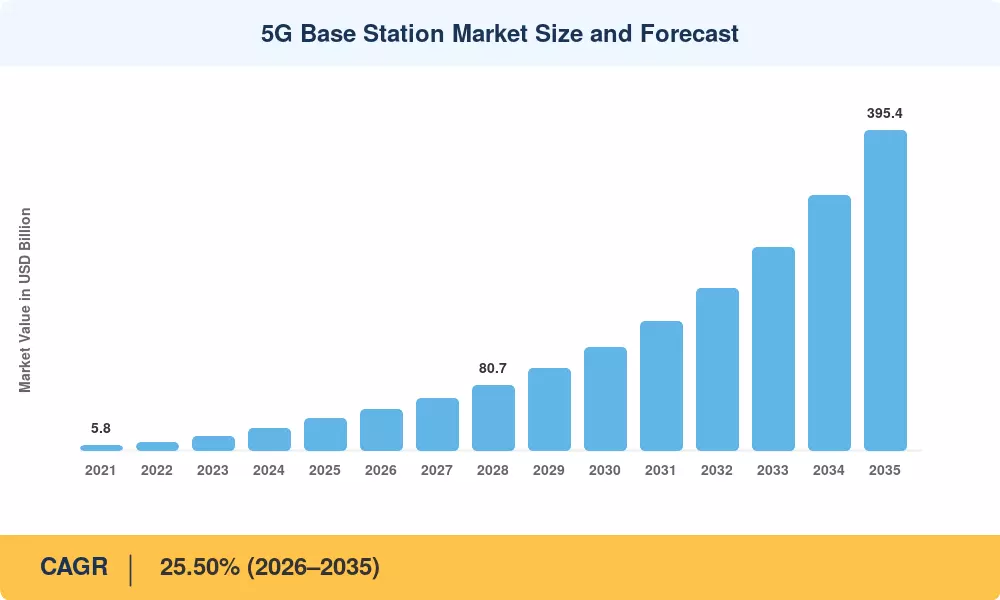
5G Base Station Market was valued at USD 40.10 Billion in 2025 and is projected to grow from USD 51.20 Billion in 2026 to USD 395.40 Billion by 2035, registering a CAGR of 25.50% during the forecast period.
Download Research Sample with Industry Insights -
https://www.marketresearchfuture.com/sample_request/10523
Market Dynamics: Drivers, Restraints and Opportunities Key Growth Drivers
Surging demand for high-bandwidth, low-latency connectivity is one of the biggest forces driving base station deployment, as consumers and enterprises increasingly rely on data-intensive applications such as video streaming, cloud computing, and augmented reality. Telecom operators are under pressure to expand network capacity to meet this demand without compromising service quality.
Government-backed digital infrastructure initiatives and spectrum allocation programs are accelerating rollout timelines across both developed and emerging markets. The rapid proliferation of Internet of Things devices, ranging from smart home products to industrial sensors, is also fueling the need for denser, more capable network infrastructure.
In addition, the growing adoption of private 5G networks by enterprises seeking secure, dedicated connectivity for automation and smart factory applications is creating a steady stream of new base station deployments outside traditional public networks.
Market Restraints and Challenges
Despite strong growth prospects, the market faces certain constraints. High capital expenditure required for base station equipment, site acquisition, and network densification remains a significant barrier, particularly for operators in cost-sensitive or rural markets where return on investment takes longer to materialize.
Complex regulatory approval processes for tower and small cell installations can delay deployment timelines, while spectrum availability and allocation policies vary widely between regions, creating inconsistency in rollout pace. Concerns around electromagnetic radiation exposure among some communities have also led to public resistance against new installations in certain areas.
Supply chain constraints affecting semiconductor components and network hardware have periodically disrupted equipment availability, adding further pressure on manufacturers and operators trying to meet aggressive deployment targets.
Emerging Opportunities
The shift toward Open RAN architecture presents a major opportunity, allowing operators to reduce dependency on single vendors and lower overall infrastructure costs while improving network flexibility. This shift is opening the door for new entrants and software-driven infrastructure providers.
Expansion of private 5G networks across manufacturing, mining, ports, and logistics hubs is creating fresh demand for specialized base station solutions tailored to industrial environments. Additionally, integration of artificial intelligence for network optimization and predictive maintenance is helping operators improve energy efficiency and reduce operational costs.
The rollout of 5G in emerging economies, supported by falling equipment costs and expanding digital inclusion programs, is expected to unlock significant untapped demand over the coming decade.
Buy this Premium Research Report -
https://www.marketresearchfuture.com/checkout?currency=one_user-USD&report_id=10523
Key Players and Competitive Insights
The 5G Base Station Market is dominated by a mix of established telecom equipment manufacturers and emerging infrastructure specialists competing on technology innovation, cost efficiency, and deployment speed. Companies are investing heavily in research and development to advance massive MIMO, beamforming, and Open RAN capabilities.
Leading Industry Participants:
• Huawei Technologies Co., Ltd.
• Ericsson
• Nokia Corporation
• Samsung Electronics Co., Ltd.
• ZTE Corporation
• Cisco Systems, Inc.
• NEC Corporation
• Fujitsu Limited
• Mavenir Systems, Inc.
• CommScope Holding Company, Inc.
• Airspan Networks Inc.
• Qualcomm Technologies, Inc.
• Ciena Corporation
• Corning Incorporated
• Ubiquiti Inc.
These companies are focusing on strategic partnerships with telecom carriers, government contracts, and technology alliances to strengthen their market position. Many vendors are also expanding manufacturing capacity and forming alliances with chipset makers to accelerate next-generation base station development.
Regional Insights
Asia-Pacific currently leads the 5G Base Station Market, driven by aggressive network rollout programs in China, South Korea, and Japan, along with strong government support for digital infrastructure. China in particular remains a major contributor, backed by large-scale domestic manufacturing and rapid urban and rural coverage expansion. Asia-Pacific accounted for 52.8% of 2025 deployments, supported by China’s macro network completion and India’s accelerating greenfield rollout.
North America follows closely, with the United States and Canada investing heavily in network densification and private 5G deployments across enterprise and industrial sectors. Favorable spectrum policies and strong telecom operator competition continue to support regional growth. North America reached USD 7.20 billion in 2025, with C-band densification and Open-RAN trials strengthening deployment opportunities.
Europe is witnessing steady expansion, supported by regulatory harmonization efforts and growing investment in Open RAN technology across Germany, the United Kingdom, and France. The European region is projected to expand at a 26.40% CAGR from 2026 to 2035, driven by vendor diversification and increasing adoption of energy-efficient RAN solutions.
South America is gradually expanding its 5G infrastructure as operators respond to rising connectivity requirements and growing fixed wireless access demand. The region was valued at USD 1.80 billion in 2025, with greenfield 3.5 GHz rollouts and increasing FWA adoption supporting future deployment.
The Middle East and Africa are also progressing, with growing mobile broadband demand and expanding smart city initiatives driving gradual base station deployment. The region is expected to register a 27.80% CAGR during 2026–2035, supported by sovereign wealth fund financing and large-scale smart-city programs.
Market Segmentations
By Component
• Hardware
• Software
• Services
By Cell Type
• Macro Cell
• Small Cell
By Frequency Band
• Sub-6 GHz
• mmWave
By Network Architecture
• Standalone (SA)
• Non-Standalone (NSA)
By End User
• Telecom Operators
• Enterprises and Industrial Users
• Government and Public Sector
• Residential
Among these segments, small cell deployments and sub-6 GHz frequency bands currently hold a significant share, owing to their cost-effective coverage advantages and suitability for dense urban network densification.
Browse In-depth Market Research Report -
https://www.marketresearchfuture.com/reports/5g-base-station-market-10523
Recent Developments
Leading telecom equipment manufacturers have been rapidly expanding their 5G portfolios, with several companies unveiling next-generation base station units featuring improved energy efficiency and compact form factors suited for urban small cell deployment.
Strategic partnerships between network operators and Open RAN vendors have increased significantly, aimed at reducing infrastructure costs while improving deployment flexibility. A number of governments have announced expanded spectrum auctions and rural connectivity funding programs to accelerate nationwide 5G coverage.
Meanwhile, several manufacturers have announced new production facilities and regional partnerships across Asia-Pacific and the Middle East to meet growing demand, while chipset makers continue to unveil advanced processors designed specifically for next-generation base station hardware.
Frequently Asked Questions
1. What is a 5G base station?
A 5G base station is network infrastructure equipment that transmits and receives radio signals to provide high-speed, low-latency wireless connectivity to devices within its coverage area.
2. What is driving growth in the 5G Base Station Market?
Rising demand for high-speed connectivity, government digital infrastructure programs, IoT proliferation, and growing adoption of private 5G networks are key growth drivers.
3. Which technology leads the 5G Base Station Market?
Small cell technology and sub-6 GHz frequency bands lead due to their cost efficiency and suitability for dense urban coverage.
4. Which region leads the 5G Base Station Market?
Asia-Pacific currently leads, supported by aggressive rollout programs and strong government backing in China, South Korea, and Japan.
5. What challenges does the 5G Base Station Market face?
High deployment costs, regulatory approval delays, spectrum allocation inconsistencies, and supply chain constraints remain key challenges.
6. Which industries use 5G base stations the most?
Telecom operators are the largest users, followed by manufacturing, logistics, and government sectors deploying private and public 5G networks.
7. What is the projected growth rate of the 5G Base Station Market?
The market is projected to grow at a CAGR of 25.50% between 2026 and 2035, reaching approximately USD 395.40 billion by the end of the forecast period.
➤➤ Market Research Future's Most Popular Reports:
Intelligent Personal Assistant Market-
https://www.marketresearchfuture.com/reports/intelligent-personal-assistant-market-1116
Analytics As A Service Market-
https://www.marketresearchfuture.com/reports/analytics-as-a-service-market-1206
Image Recognition Market-
https://www.marketresearchfuture.com/reports/image-recognition-market-1315
High Performance Data Analytics Market-
https://www.marketresearchfuture.com/reports/high-performance-data-analytics-hpda-market-1828
Machine Learning As A Service Market-
https://www.marketresearchfuture.com/reports/machine-learning-as-a-service-market-2505
Transportation Predictive Analytics Market-
https://www.marketresearchfuture.com/reports/transportation-predictive-analytics-market-2672
Edge Analytics Market-
https://www.marketresearchfuture.com/reports/edge-analytics-market-3192
Cognitive Analytics Market-
https://www.marketresearchfuture.com/reports/cognitive-analytics-market-4086
Software Analytics Market-
https://www.marketresearchfuture.com/reports/software-analytics-market-4270
Language Translation Software Market-
https://www.marketresearchfuture.com/reports/language-translation-software-market-4452
Customer Journey Analytics Market-
https://www.marketresearchfuture.com/reports/customer-journey-analytics-market-4536
Cognitive Assessment And Training Market-
https://www.marketresearchfuture.com/reports/cognitive-assessment-training-market-4677
Market Research Future
Market Research Future
+1 855-661-4441
email us here
Legal Disclaimer:
EIN Presswire provides this news content "as is" without warranty of any kind. We do not accept any responsibility or liability for the accuracy, content, images, videos, licenses, completeness, legality, or reliability of the information contained in this article. If you have any complaints or copyright issues related to this article, kindly contact the author above.
